


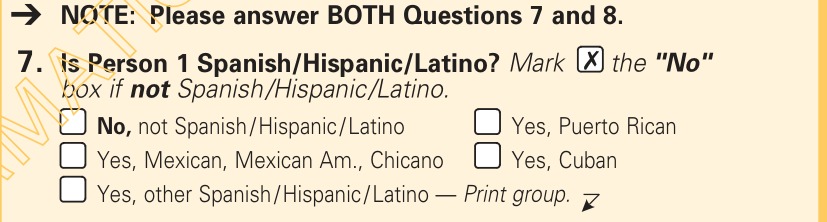
The history of the word Hispanic as an official category is shorter than the communities it now counts. In 1970, the Census Bureau says, “for the first time, a separate question on Hispanic origin or descent was asked, but only of a 5 percent sample of the population.” The word Hispanic was not in the question. The options ran through Mexican, Puerto Rican, Cuban, Central or South American, and at the end, a box labeled “Other Spanish.”
By 2020 the Census Bureau counted 62.1 million people in the Hispanic or Latino population. The federal label took shape over decades, and this post follows it.
The short history of the word Hispanic in federal records
The 1930 Census listed “Mexican” as a race. The Census Bureau says it was the first and only time.
In 1970, the question reached only a 5 percent sample. Pew Research reports that the total count of 9.1 million was about 500,000 less than other estimates for the Hispanic population. The word Hispanic was still not the word the form used. The options were Mexican, Puerto Rican, Cuban, Central or South American, Other Spanish, and a “No, none of these” response.
In 1976, Congress passed a law directing the federal government to build a data program on Americans of Spanish origin or descent. The law’s own text used the phrase “Americans of Spanish origin or descent.” The word Hispanic did not appear in it. Pew Research says the law was meant to help decision makers understand the fast-growing Hispanic population, “but it also grouped a diverse people under a single umbrella.”
The federal definition followed the next year. On May 12, 1977, the Office of Management and Budget adopted the first official classification: “A person of Mexican, Puerto Rican, Cuban, Central or South American or other Spanish culture or origin, regardless of race.” That was the first federal standard, and OMB revised it in 1997.
In 1980, the question finally reached the full population. A question on Spanish or Hispanic origin or descent was added to the 100-percent portion of the decennial census for the first time, having been asked of only 5 percent in 1970. The form item read: “Is this person of Spanish/Hispanic origin or descent?” The count returned 14.6 million people.


By 1997, the Office of Management and Budget revised its standards and chose to add a second term alongside Hispanic. OMB decided the classification should read “Hispanic or Latino” rather than “Hispanic” alone. The reasoning given: Hispanic was more commonly used in the eastern United States, while Latino was more commonly used in the western portion, and the addition might improve response rates. The 2000 Census form carried the combined phrasing for the first time, asking: “Is this person Spanish/Hispanic/Latino?”

The 2020 form asked two questions, one on origin and one on race. The origin question asked: “Is Person 1 of Hispanic, Latino, or Spanish origin?” with options for Mexican, Mexican Am., Chicano; Puerto Rican; Cuban; or another Hispanic, Latino, or Spanish origin. The race question that followed included a write-in field for American Indian or Alaska Native, with a prompt to “Print name of enrolled or principal tribe(s)” alongside examples including Navajo Nation, Blackfeet Tribe, Mayan, and Aztec. A note on the form read: “For this census, Hispanic origins are not races.”
Who the category includes, and who it leaves out
Pew Research describes the group as including “around 20 Spanish-speaking nations from Latin America and Spain itself, but not Portugal or Portuguese-speaking Brazil.” Someone from Spain falls inside the federal definition. Someone from Brazil does not, because the official classification applies only to people of Spanish culture or origin.
The Census Bureau states plainly that its racial and ethnic standards “reflect a social definition of race and ethnicity recognized in this country” and “do not conform to any biological, anthropological, or genetic criteria.” The category is a social and administrative creation. The communities inside it helped draw its borders, partly by demanding to be seen in the first place.
How people describe themselves
A Pew Research survey of 4,923 Hispanic adults, conducted in October 2025, asked how people in this group most often describe themselves. The results showed more variety than any single label captures.
Fifty-three percent describe themselves by their country of origin, either alone or combined with “American.” Twenty-seven percent use pan-ethnic terms like Hispanic, Latino, Latinx, or Latine, either alone or combined with “American.” Eighteen percent describe themselves as only American.
Among those who chose a pan-ethnic term as their preference for describing the population overall, 54 percent chose Hispanic, 30 percent chose Latino, and 14 percent had no preference.
Nearly everyone in the survey had used a pan-ethnic term at some point: 84 percent said they had used one at least once. And 80 percent said they had used their family’s country of origin on its own. Most people in the survey have used both kinds of label.
What the form still cannot fully count
Two populations within the Hispanic or Latino group show clearly what a single checkbox cannot hold: people who are both Black and Hispanic, and people with Indigenous heritage.
In the 2020 Census, on the race question, nearly 1.2 million people identified as Black Hispanic alone, and 2.6 million identified as Black Hispanic alone or in combination. A separate Pew Research study, published in 2022, found approximately 6 million Afro-Latino adults in the United States in 2020. That figure came from asking directly about Afro-Latino identity, rather than counting anyone who marked both Hispanic on the ethnicity question and Black on the race question. The Census Bureau’s own working paper notes that “neither tabulation of these specific terms, from the ethnicity question or the race question, reflects the total count of people who identify as Black Hispanics.” The number you get depends on the question you ask.
The same is true of Indigenous heritage. On the race question in 2020, 1,475,436 people who also identified as Hispanic or Latino on the ethnicity question selected American Indian or Alaska Native alone. That figure covers only people who marked American Indian or Alaska Native on the race question.
How the category was built
G. Cristina Mora, a sociologist at UC Berkeley and the author of Making Hispanics (2014), has traced how the label came to exist. Her account: “It was the activists who first went to the Census Bureau and said, ‘You have got to create a category. You have got to distinguish us from whites.'” The Bureau then asked those same activists, along with Spanish-language media, to promote the new category to the communities it would count.
Mora has also said that reading the label’s origins as purely a federal bureaucratic story misses something real: “emphasizing the state neglects that this was also a real fight for recognition, that Mexican and Puerto Rican leaders had to organize and really make the government pay attention to them.”
I am Mexican, and part Zuni and part other tribes that went unnamed. I speak only for myself.
A form that counts a population needs a box. The history of this box, as Mora tells it, is a negotiation between what communities asked for and what the Census Bureau agreed to create.
What is one part of your family’s history that a form has never had room for? Leave it in the comments. Or, if you would add a layer this post did not reach, tell me what it is. I would genuinely love to read it.
Sources
- 1930 “Mexican” race
- 1970 question (5% sample)
- 1970 form options
- 1970 undercount
- 1976 law (no “Hispanic” in text)
- 1976 law’s grouping effect
- 1977 OMB definition (May 12, 1977)
- 1980 question and 100% for first time
- 1997 OMB decision
- 2000 form question
- 2020 form and note
- 2020 total Hispanic population
- Spain in, Brazil out
- Census Bureau social definition
- Afro-Latino, race question method
- Afro-Latino, direct identity question method
- Indigenous count, race question only
- G. Cristina Mora, UC Berkeley sociologist, Making Hispanics (2014)
- G. Cristina Mora