

Content note: this post mentions political violence, including killings.
In 1992, the year of the five-hundredth anniversary of Columbus’s arrival in the Americas, the Norwegian Nobel Committee awarded the Peace Prize to a Guatemalan Indigenous woman. Indigenous organizations had lobbied for her nomination, the Nobel Foundation records, because “they wanted to draw attention to the fact that the European discovery of America had entailed the extermination and suppression of indigenous populations.” The Committee noted that “it was a happy coincidence that it was precisely in the year of Columbus that she emerged as such a strong candidate for the Nobel Peace Prize.”
That woman was Rigoberta Menchú Tum.

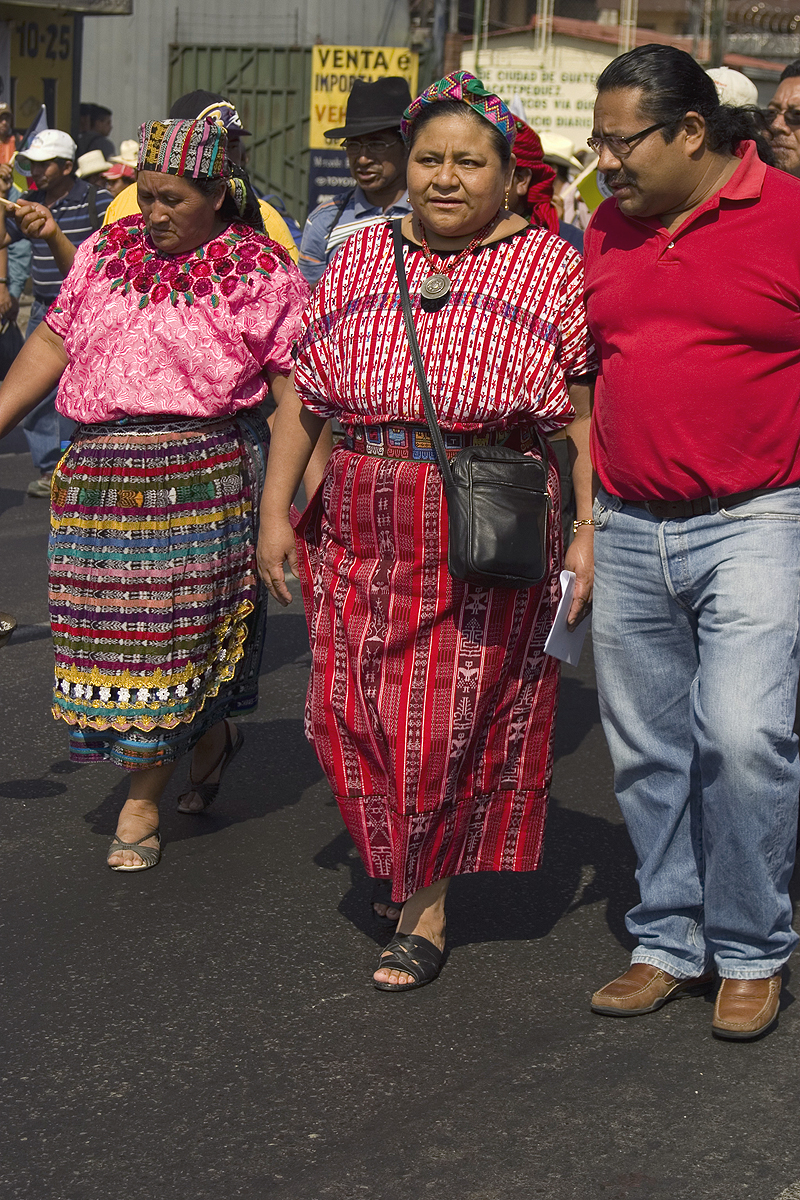
Who she is, in her own words
She was “born on January 9, 1959 to a poor Indian peasant family and raised in the Quiche branch of the Maya culture,” the Nobel biography records. In her Nobel Lecture on December 10, 1992, she spoke as “this Quiché Indian” and as a member of “the indigenous peoples, of which I am a member.” The Nobel presentation speech identifies her directly: “Rigoberta Menchú Tum is a Quiché Indian.”
These are the words the 1992 sources use. The modern spelling of her people is K’iche’.
What the prize recognized
The Committee awarded the 1992 Peace Prize to Rigoberta Menchú Tum “for her struggle for social justice and ethno-cultural reconciliation based on respect for the rights of indigenous peoples.”
In 1979 she joined the Committee of the Peasant Union (CUC). In 1981 she went into hiding in Guatemala, then fled to Mexico. From exile she continued organizing, and from the late 1980s actively promoted reconciliation with the Guatemalan authorities to help bring an end to the civil war. She became, the Nobel presentation speech records, “one of the first Indian delegates to the United Nations, and is a member of the UN group that works for human rights and the cause of the Indian peoples.” In December 1993, a UN General Assembly resolution on the International Year of the World’s Indigenous People expressed appreciation for work done for the Year by “the Goodwill Ambassador, Ms. Rigoberta Menchu.”
In her Nobel Lecture she named what she understood the prize to mean: “I consider this Prize, not as a reward to me personally, but rather as one of the greatest conquests in the struggle for peace, for Human Rights and for the rights of the indigenous people.”
What the truth commission found
The Commission for Historical Clarification, a truth commission supported by the United Nations, produced an accounting of Guatemala’s civil war period. Its report registered a total of 42,275 victims, including men, women and children. Of fully identified victims, eighty-three percent were Mayan and seventeen percent were Ladino.
The commission found that “state forces and related paramilitary groups were responsible for 93% of the violations documented by the CEH.” Acts attributable to the guerrillas represent 3 percent of the violations the commission registered. The report also records that “this disparity does not lessen the gravity of the unjustifiable offences committed by the guerrillas against human rights.”
For the years 1981 to 1983, the commission found that “agents of the State of Guatemala, within the framework of counterinsurgency operations carried out between 1981 and 1983, committed acts of genocide against groups of Mayan people which lived in the four regions analysed.”
The commission’s own chronology marks 1992 as “New impetus to the Mayan movement, after Rigoberta Menchu Tum is awarded the Nobel Peace Prize.”
Her family
The Nobel speed read records: “Both parents and one of her brothers were killed by the army in its pursuit of genuine or alleged communists.” Stoll’s account, quoted below, counts four family members. The sources differ.
A documented dispute about her book
In 1983 she told her life story to Elisabeth Burgos Debray. The Nobel biography describes the account as “based on a week of recorded interviews with the editor, a Latin American anthropologist, who revised and arranged the transcripts.” The resulting book, known in English as I, Rigoberta Menchú, “is a gripping human document which attracted considerable international attention.”
In 1999 US researcher David Stoll published a book that, the Nobel biography records, “shows that parts of her own and her family history are not correct, even when she speaks as an eyewitness of events described.” The Nobel speed read adds that he “claimed she was more closely affiliated with a communist guerilla group than she was willing to admit.” Publishers Weekly reported Stoll as saying his book “is not a hoax” and, of her: “She is not a liar. She’s a genuine victim who lost four members of her family to the security forces.” He also stated, the Nobel biography records, that he had “no question about the picture of army atrocities which she presents.”
Publishers Weekly reported that at a New York press conference on February 11, 1999, she called the book “a testimony, not a biography.”
Geir Lundestad, secretary of the Norwegian Nobel Committee, said the decision “was not based exclusively or primarily on the autobiography” and, the Nobel biography records, “dismissed any suggestion that the Committee should consider revoking the prize.”
The label, and how she named herself
None of the sources consulted for this post apply “Hispanic” or “Latina” to her. The current US federal definition of Hispanic or Latino, set in standards for federal data on race and ethnicity, lists “individuals of Mexican, Puerto Rican, Salvadoran, Cuban, Dominican, Guatemalan, and other Central or South American or Spanish culture or origin.” The Nobel Foundation calls her “the Guatemalan indigenous woman Rigoberta Menchú.”
Her 1992 Nobel Lecture used “indigenous peoples,” “Maya,” and “Quiché.” Her words: “the revival of hope for the oppressed indigenous peoples demands that we reassert our existence to the world and the value of our cultural identity. It is not possible to conceive a democratic Guatemala, free and independent, without the indigenous identity shaping its character into all aspects of national existence.”
Which part of this stays with you? Or tell me what you think belongs in this conversation that I haven’t named yet.
Sources
- Nobel Foundation facts
- Nobel biography
- Nobel speed read
- Presentation speech
- Nobel Lecture, 10 December 1992
- UN General Assembly resolution 48/133, 20 Dec 1993
- Commission for Historical Clarification, “Guatemala: Memory of Silence
- Publishers Weekly, 8 March 1999
- Federal Register, 29 March 2024
- 2020 census form