

National Hispanic Heritage Month runs from September 15 to October 15, the National Archives says. Sandra Cisneros, speaking with Krista Tippett on On Being in 2020, said:

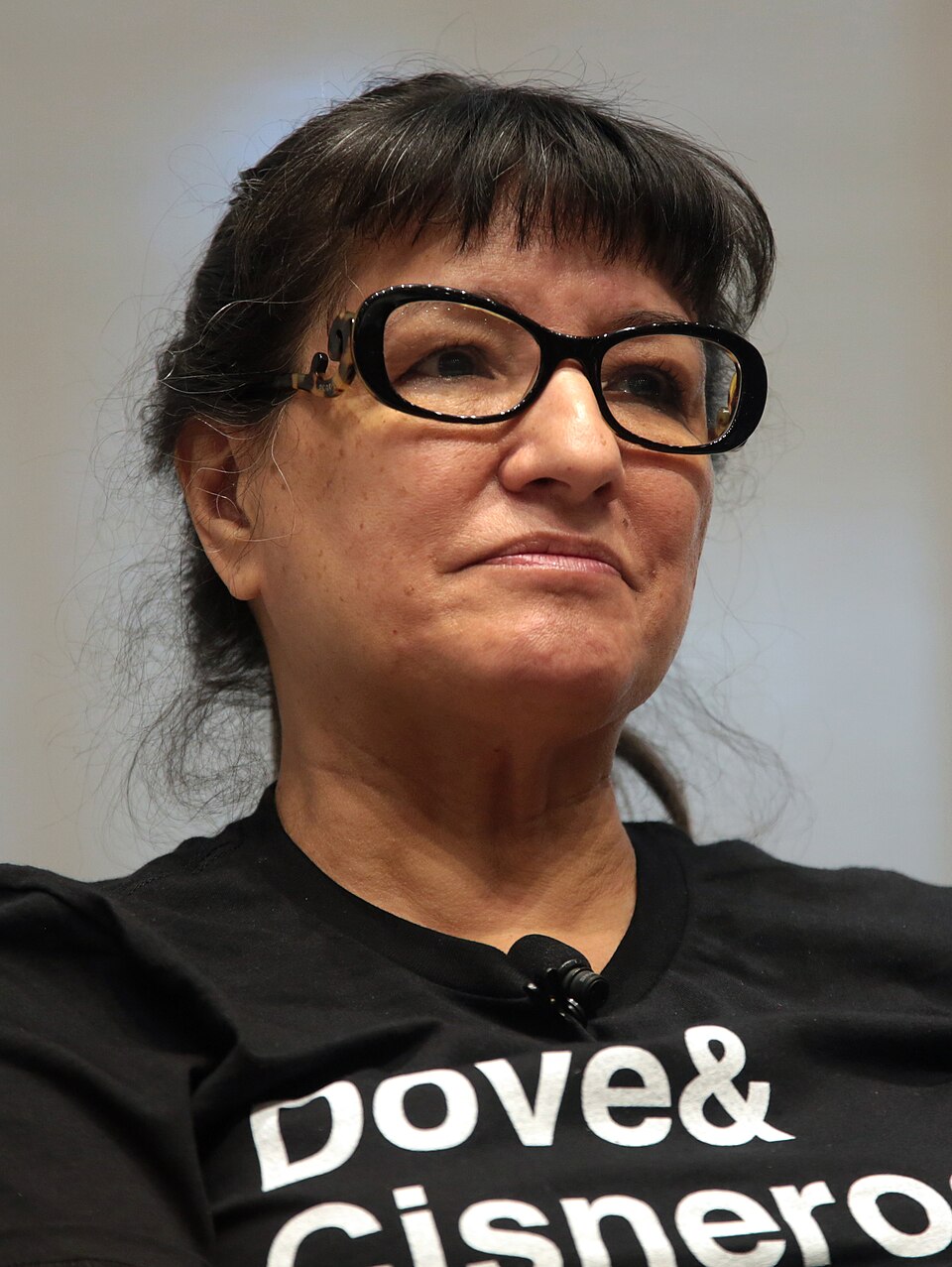
“I don’t mind being on the cover; I just don’t like the word ‘Hispanic.'”
Chicago, the first years
“I was born in Chicago in 1954, the third child and only daughter in a family of seven children.” That is how she describes herself on her own website.
The family resided for the majority of her youth in the Humboldt Park neighborhood. According to the Chicago Public Library, the Cisneros family traveled frequently between Chicago and Mexico to visit relatives.
In a 2021 Iowa Public Radio interview, she said: “When you are a girl, you are invisible, especially if you are a Mexican girl.”
In a 2002 Missouri Review interview, she described a graduate seminar:
“I was a working-class person with very privileged classmates, it caused me eventually to become angry and to write from that place of difference. Now I realize that place of difference is my gift.”
In the same Iowa Public Radio interview, she added: “I started discovering my politics, my feminism, my roots as a working-class woman, as the daughter of an immigrant.”
The House on Mango Street
The House on Mango Street was first published in 1984. The MacArthur Foundation describes it as taking “the form of a series of vignettes told from the perspective of a young girl growing up in Chicago.”
The Chicago Public Library notes that the house from the title is a composite of the author’s many homes.
The book won the Before Columbus Foundation’s American Book Award in 1985.
Recognition
In 1995, the MacArthur Foundation named her a fellow. The foundation describes her work as giving “voice to working-class Latino and Latina life in America.”
The National Endowment for the Arts lists her as a 2015 National Medal of Arts recipient. The National Endowment for the Arts citation reads:
“For enriching the American narrative. Through her novels, short stories, and poetry, she explores issues of race, class, and gender through the lives of ordinary people straddling multiple cultures. As an educator, she has deepened our understanding of American identity.”
The words she uses for herself
Several institutions use different labels. The MacArthur Foundation calls her work a voice for “working-class Latino and Latina life.” Penguin Random House describes her as “a celebrated Mexican American novelist, poet and short story writer.” A 2003 Texas House resolution says she “found her voice as a Chicana author.”
She describes herself in her own terms. On On Being in 2020:
“I’m a Latina, a Mexican American; I’m American; I’m Mexican; I’m from las Americas north and south. That’s what I feel I am.”
On the word “Hispanic”:
“‘An Hispanic.’ But some people feel they are, and that’s fine. I don’t. And I have my reasons.”
She named one reason: “it wasn’t something that was organic from my community, so I felt a resistance to it.” And: “That word came up like that, overnight.”
On “Chicana,” from a 2006 interview excerpt reposted by MALCS (a secondary source):
“It’s like the word ‘feminist.’ You’re not born with it. You have to understand the political history of the word.” She continued: “Chicano is being used for picking up the struggle for people on both sides of the border. It became a political term, the same way feminist did.”
Which of these words feels closest to how you name yourself?
Or tell me what you would add.
Sources
- On Being with Krista Tippett, aired 2020-02-13 |
- Her site |
- Chicago Public Library |
- Missouri Review, Spring 2002 |
- Iowa Public Radio, July 16, 2021 |
- MacArthur Foundation |
- National Endowment for the Arts |
- White House advisory, September 14, 2016 |
- Penguin Random House, February 14, 2019 |
- Texas House resolution, 2003 |
- MALCS repost of 2006 interview excerpt |
- National Archives