Content note: this post includes a mention of forced sterilization.
Helen Rodríguez-Trías was born on July 7, 1929, in New York City to Puerto Rican parents.
She graduated from medical school in 1960 at the age of 31, the American Journal of Public Health records. The National Library of Medicine adds that she earned her medical degree with highest honors.
She completed her residency at University Hospital in San Juan, the American Journal of Public Health records. During it, the National Library of Medicine records, she established the first center for the care of newborn babies in Puerto Rico. Under her direction, the hospital’s death rate for newborns decreased 50 percent within three years.
At Lincoln Hospital, the South Bronx
She came next to Lincoln Hospital, which the National Library of Medicine describes as serving “a largely Puerto Rican section of the South Bronx,” where she headed the department of pediatrics. Her patients there, the National Library of Medicine records, were “among the lowest-income populations in the United States at that time” and were “struggling for greater political power and better health care.”
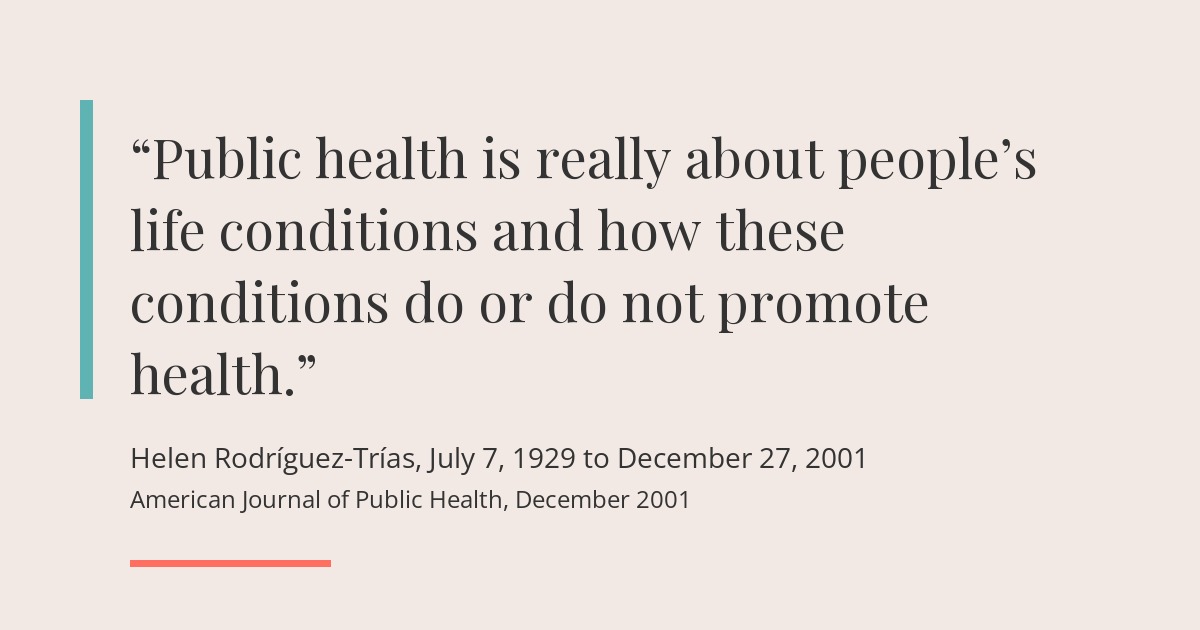
The National Library of Medicine records that Rodríguez-Trías “lobbied to give all workers a voice in administrative and patient-care issues.” In the American Journal of Public Health, she said: “Public health is really about people’s life conditions and how these conditions do or do not promote health.”
Helen Rodríguez-Trías and the Federal Guidelines
In the 1970s, Rodríguez-Trías became a founding member of both the Committee to End Sterilization Abuse and the Committee for Abortion Rights and Against Sterilization Abuse, according to the National Library of Medicine. The American Journal of Public Health records that these committees “were among the groups instrumental in bringing about federal sterilization guidelines in 1979.”
Of the women she was working with, she said, in words the National Park Service quotes: “While young white middle class women were denied their requests for sterilization, low income women of certain ethnicity were misled or coerced into them.”
In words recorded on the National Library of Medicine’s biography of her, Rodríguez-Trías named what she saw: “Puerto Rico was being used as a laboratory for the development of birth control technology.” She also said: “there is a difference between population control and birth control.”
Of her time in the women’s movement, she said in the American Journal of Public Health: “I began to understand that we were coming to different conclusions because we were living different realities.”
In its account of her work in Puerto Rico, the National Library of Medicine records that “between 1938 and 1968, a third of the women of child-bearing age were sterilized without being fully informed of its consequences.”
Rodríguez-Trías testified before the Department of Health, Education, and Welfare for passage of federal sterilization guidelines. The National Library of Medicine records that the guidelines, which she helped draft, “require a woman’s written consent to sterilization, offered in a language they can understand, and set a waiting period between the consent and the sterilization procedure.” Per the Federal Register, these rules took effect on February 6, 1979. The regulations as codified in the Code of Federal Regulations set additional specifics: a woman must be at least 21 years old at the time consent is obtained, and at least 30 days but no more than 180 days must pass between the date of informed consent and the date of the sterilization.
The Later Years
In the 1980s, Rodríguez-Trías served as medical director of the New York State Department of Health AIDS Institute, where, the National Library of Medicine records, “she worked on behalf of women with HIV.”
In 1993, she served as president of the American Public Health Association. The APHA’s own list of past presidents records her for that year. The National Library of Medicine records her as the first Latina to be elected president of the organization.
On January 8, 2001, President Clinton presented her with the Presidential Citizens Medal. The White House citation recorded that she “has challenged discriminatory practices in health care, encouraged community involvement in creating healthy environments, worked to prevent the spread of AIDS.”
Helen Rodríguez-Trías died on December 27, 2001.
The American Public Health Association has named an award in her honor. The APHA describes it as named “after the late Dr. Helen Rodriguez-Trias, past president of APHA and a pediatrician.”
Which part of her work stays with you? Share it in the comments. Or tell me what you would add.
Sources
- National Library of Medicine, “Helen Rodriguez Trias
- National Park Service, “Dr. Helen Rodríguez-Trías
- American Journal of Public Health, December 2001
- Federal Register, November 8, 1978
- Code of Federal Regulations, 42 CFR 441.253
- APHA Past Presidents
- APHA Helen Rodriguez-Trias Award
- White House Archive, January 8, 2001
Leave a Reply
You must be logged in to post a comment.